By Greg Clough
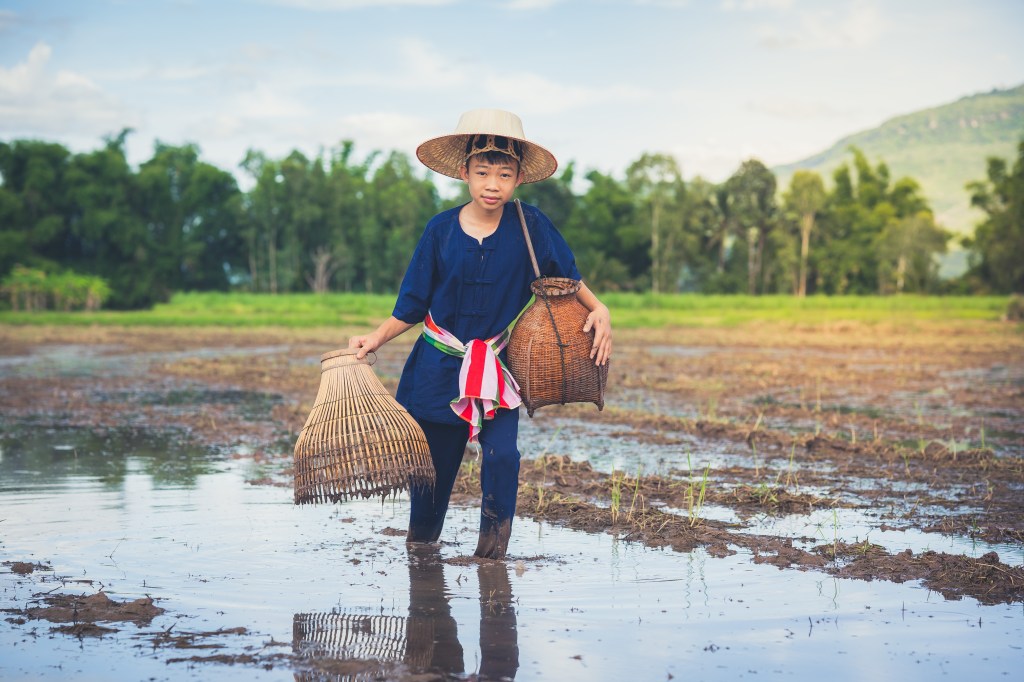
Photo: A farmer catches fish in a rice field in Asia.
Shutterstock – Torychemistry
To the untrained eye, rice paddies, fishing spots and forests may seem worlds apart. But they have a lot in common. The integrated way they are managed to produce food, provide livelihoods, protect biodiversity and combat tclimate change overlap in many ways. These blended management approaches may seem novel, but their genesis goes back hundreds of years.
Let’s start with forests. In particular, agroforestry, which has garnered scientific acclaim in recent decades. Since the mid-20th century, It has evolved into an agricultural discipline globally recognized as a viable and sustainable approach to farming and cultivation. Despite its recent recognition, the Indigenous people of Africa and the Americas have been practicing agroforestry since time immemorial, integrating forests with farming systems to provide sustenance and shelter.
Honouring Indigenous wisdom
Similarly, rice-fish farming also has the feel of contemporaneity, having garnered attention over the past fifty years with numerous scientific papers. However, farmers in Asia have been practicing rice-fish farming for centuries, reaping benefits such as enhanced agricultural productivity, food security, smallholder livelihoods and resource conservation.
The fact that rice-fish farming and agroforestry date back hundreds of years and still excite scientists demonstrates the importance of understanding Indigenous land and resource management. It represents a shift in farming practices, from violently transmuting Indigenous woodlands and forests into horizon-bound pastures and neat orchard rows, to respecting rich Indigenous knowledge and skill in sustaianably stewarding the environment. What’s old is new again.
Protecting the environment, promoting biodiversity
Rice-fish farming and agroforestry exhibit a remarkable harmony between human activities, environmental stewardship, and biodiversity conservation.
Rice-fish farming involves cultivating rice crops and rearing fish in the same field or nearby water bodies. It’s a good deal for both farming outputs. In simple terms, the rice yields benefit from the fish controlling pests and weeds, while the fish benefit from the rice plants’ nutrient-rich water and organic matter.
Rice-fish farming is also a good deal for the environment. Fish eat pests and excrete in the fields, reducing the need for pesticides and fertilizer, and improving water quality. Fish also stir the water, reducing stagnant conditions and leading to better oxygenation and a healthier aquatic environment.
Rice-fish farming isn’t only about compatibility between fish and rice. Importantly, it’s about fostering biodiversity too. Farmers can use their rice fields to raise different fish species, creating thriving feeding and nesting grounds for waterbirds. Also, rice-fish farmers often intermix rice fields with trees and other vegetation, creating corridors between habitats that facilitate movement and gene flow for different species.
Agroforestry involves cultivating trees or woody shrubs, rearing livestock, or raising crops on the same land. It’s a win for trees, shrubs, crops and livestock. Again, in straightforward terms, livestock manure and the nutrients trees bring to the surface feed the crops. Meanwhile, the crops fight the weeds for sunlight, water, and nutrients, restricting the weeds from competing with the trees.
It’s also a win for the environment. Tree roots bind the soil, reducing erosion. Their canopies shade soils from direct sunlight, reducing evaporation and keeping the soil moist. Fallen leaves contribute to nutrient cycling, improving soil fertility and, as with rice-fish farming, reducing pesticide and fertilizer use.
Agroforestry promotes biodiversity by creating habitats that support a range of organisms, nesting sites for birds and shelter for insects and wildlife. The diverse plant species in agroforests attract benevolent insects, aiding in pest control and crop pollination. Biodiversity-friendly agroforestry abounds. One example is in northwest Vietnam, where women farmers draw on Indigenous knowledge and manage coffee agroforestry systems that reduce fertilizers and fungicides, encouraging biodiversity and sequestering carbon up to three to four times higher than coffee monocultures.[i] In Kyrgyzstan’s arid region of Batken, agroforestry systems are generating peach, apple, apricot, and cherry trees and providing a home to hedgehogs, hares and lynx.[ii]
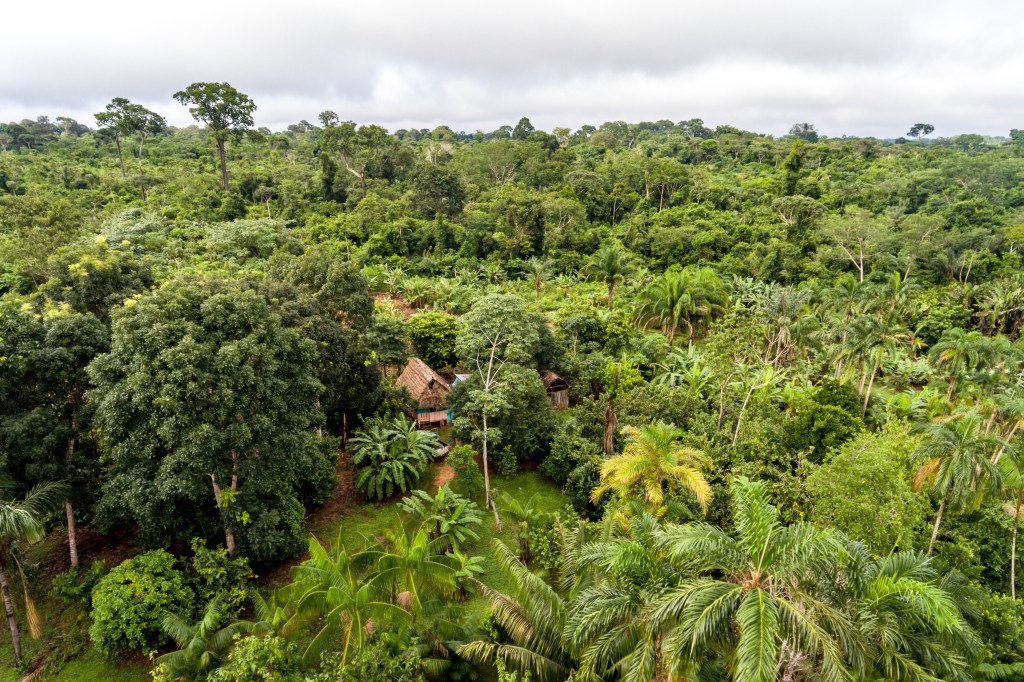
Photo: Shutterstock – Alexandre Laprise
Combatting climate change
The parallels between rice-fish farming and agroforestry are many and varied. Such parallels occur with many agricultural practices. One commonality not yet mentioned is how the integrated nature of rice-fish farming and agroforestry helps combat the climate crisis.
Trees store carbon, effectively reducing greenhouse gas (GHG) concentrations and mitigating climate change. In rice-fish farming, as noted above, the fish stir the water. This distributes oxygen, preventing the development of methanogens, bacteria that emit methane, a potent greenhouse gas 30 times more powerful than carbon dioxide at trapping heat in the atmosphere.[iii] A good example of rice-fish farming reducing GHG emissions is an FAO project in Nigeria, helping small landholders improve their rice yields while decreasing their GHG emissions.[iv] A project in California is targeting 200,000 hectares of flooded rice fields to produce a new source of protein while cutting methane emissions.[v]
Embracing sustainable landscape management
Ultimately, rice-fish farming and agroforestry exemplify the broader concept of sustainable landscape management (SLM). While research on SLM gained traction in the 1970s, as with rice-fish farming and agroforestry, its roots extend back centuries to traditional farming practices like crop rotation and cover cropping. SLM focuses on achieving sustainable outcomes by integrating social, economic, and environmental considerations. The FAO defines SLM best as “the use of land resources, including soils, water, animals and plants, for the production of goods to meet changing human needs, while simultaneously ensuring the long-term productive potential of these resources and the maintenance of their environmental functions.”[vi] By applying SLM principles to a wide range of landscapes, including agricultural ones, we can design and maintain resilient, productive, and environmentally sound landscapes.
And in the end
As we face the challenges of food security, biodiversity loss, and climate change, embracing integrated and sustainable approaches like rice-fish farming, agroforestry, and sustainable landscape management becomes increasingly critical. These practices, rooted in ancient wisdom, provide valuable insights and solutions for a sustainable future. By balancing the needs of people, the environment, and the economy, we can create landscapes that sustain us and ensure future generations’ well-being. Let us embrace these time-tested practices and harness the power of nature to build a brighter and more sustainable world.
[i] Women coffee growers in Vietnam boost climate mitigation through agroforestry
[ii] Business and biodiversity benefit from Kyrgyz agroforestry systems
[iv] Integrated Rice-Fish Farming in Nigeria: A Resilient Approach in the Face of Climate Change
[vi] Sustainable Land Management
Further resources about rice-fish farming, agroforestry and sustainable landscape management
World Fish Centre: Back to the future: integrating rice-fish systems for building resilience
International Rice Research Centre: Rice-fish culture helps make rice production sustainable
Consultative Group on International Agricultural Research: Inclusive sustainable landscape management in West and Central Africa
Centre for International Forestry Research: Ten principles for a landscape approach to reconciling agriculture, conservation, and other competing land uses
Global Landscape Forum: Connect. Share. Learn. Act
Consultative Group on International Agricultural Research: Rice–fish farming gets a makeover